
 Facebook
 X
X LinkedIn
 Forward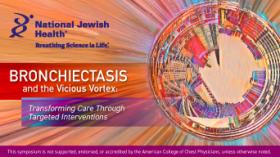
Bronchiectasis and the Vicious Vortex: Transforming Care Through Targeted Interventions
Provider Statement
This activity is provided by National Jewish Health.
Support Statement
Supported by an educational grant from Insmed.
Program Description
Non-cystic fibrosis bronchiectasis (NCFBE) is a complex and progressive respiratory disease characterized by a self-perpetuating cycle of chronic airway inflammation, recurrent infections, and structural bronchial damage—often termed the “vicious vortex.” In this cycle, infections trigger inflammation that disrupts mucociliary clearance, predisposing patients to further infections and ongoing lung injury. As the burden of bronchiectasis gains greater recognition, there is an urgent need to deepen understanding of neutrophilic mechanisms while improving early diagnosis and exploring innovative therapeutic options that disrupt this destructive cycle. Recently, promising advances have emerged with therapies targeting dipeptidyl peptidase 1 (DPP1) and inhibiting neutrophil serine proteases, which have shown potential to mitigate neutrophilic inflammation and improve outcomes. This novel mechanism of action represents a meaningful shift in the treatment paradigm, offering the possibility to alter disease progression. By engaging healthcare providers in cutting-edge research and evolving therapeutic strategies, this program aims to support evidence-based decision-making and ultimately enhance patient care in bronchiectasis.
Target Audience
Primary Care Physicians, Pulmonologists, Radiologists, as well as Nurse Practitioners and Physician Assistants in those specialties.
Learning Objectives
- Apply clinical practice guidelines and best practices for the diagnosis of bronchiectasis.
- Analyze the diverse mechanisms and neutrophilic inflammation underlying bronchiectasis pathophysiology.
- Incorporate best practices for the management of bronchiectasis.
- Evaluate data for emerging therapeutic approaches that target bronchiectasis pathophysiologic processes.
You may also be interested in
Course summary
- 1.00 ABIM Medical Knowledge
- 1.00 AMA PRA Category 1 Credit™
- 1.00 Participation

Charles Daley, MD
Professor of Medicine
Chief, Division of Mycobacterial & Respiratory Infections
National Jewish Health
Denver, Colorado

Steven E. Lommatzsch, MD
Associate Professor of Medicine
Director, Non-CF Bronchiectasis Program
PCD Clinic Co-Director
Division of Pulmonary, Critical Care, & Sleep Medicine
National Jewish Health
Denver, Colorado

B. Shoshana Zha, MD, PhD
Assistant Professor, Medicine
Division of Pulmonary, Critical Care, Allergy, and Sleep Medicine
Director, Bronchiectasis and Pulmonary Clinical NTM
University of California-San Fransico
San Franisco, California
Conflicts of Interest Disclosure Policy
In accordance with the Accreditation Council for Continuing Medical Education (ACCME), National Jewish Health requires that all program faculty, content developers, reviewers, and others in a position to control the content of this activity disclose to learners the presence or absence of any relevant financial relationships with an ACCME-defined ineligible company within the preceding 24 months of the activity. The ACCME defines an “ineligible company” as one whose primary business is producing, marketing, selling, re-selling, or distributing healthcare products used by or on patients.
Our goal is to ensure that there is no compromise in the ethical relationship that exists between those in a position to control the content of the activity and those participating in the activity and their respective professional duties. All accredited education activities offered by National Jewish Health are reviewed to ensure a balanced and evidence-based presentation.
All relevant financial relationships among individuals in a position to control the content of this activity have been identified and mitigated according to the Standards of Integrity and Independence in Accredited Continuing Education.
Faculty reports the following relevant financial relationship(s)
Charles Daley, MD discloses the following relevant financial relationships:
Advisory Board: AN2, AstraZeneca, Hyfe, Insmed, MannKind, MicuRx, Monoghan, Nob Hill, Paratek, Spero
Consultant: AN2, Insmed, Paratek
Investigator: AN2, Insmed, Juvabis, MannKind, Paratek
Stock Options: Hyfe, Nob Hill
Steven E. Lommatzsch, MD discloses the following relevant financial relationships:
Investigator: Insmed, Sanofi, Verona
Consultant: Mannkind
B. Shoshana Zha, MD, PhD discloses the following relevant financial relationships:
Consultant: Boehringer Ingelheim, Genentech, Insmed
Investigator: Insmed
Dana Boussard does not have any relevant financial relationships to disclose.
Planners and reviewers report the following relationship(s)
Meghan Brenner, MA does not have any relevant financial relationships to disclose. Meghan Brenner, MA
Bryce Chitanavong, MBA does not have any relevant financial relationships to disclose
Andrea Harshman, MHA, CHCP, CMP-HC does not have any relevant financial relationships to disclose.
Edward Chan, MD does not have any relevant financial relationships to disclose.
Unlabeled and Investigational Usage
The faculty of this educational activity may include discussions of products or devices that are not currently labeled for use by the FDA. Faculty members have been advised to disclose to the audience any reference to an unlabeled or investigational use.
No endorsement of unapproved products or uses is made or implied by coverage of these products or uses.
Please refer to the official prescribing information for each product for discussion of approved indicators, contraindications and warnings.
Disclaimer Statement
National Jewish Health (“NJH”) and its officers, Board of Directors, faculty, employees, representatives, and other agents (collectively, “NJH Parties”) shall not be responsible in any capacity for, and do not warrant any content whatsoever, in any NJH publication or other product (in any medium), or the use or reliance on any such content, and expressly disclaim any and all liability for such content. All such responsibility for content and use of product solely rests with the authors or the advertisers, as the case may be.
By way of example, without limiting the foregoing, this disclaimer of liability applies to the accuracy, completeness, effectiveness, quality, appearance, ideas, or products, as the case may be, of or resulting from, any statements, references, articles, positions, claimed diagnosis, claimed possible treatments, services, or advertising, express or implied, contained in any NJH live meeting, publication, online course or other product.
Furthermore, the content should not be considered medical advice and is not intended to replace consultation with a qualified medical professional. Under no circumstances, including negligence, shall any of the NJH Parties be liable for any DIRECT, INDIRECT, INCIDENTAL, SPECIAL or CONSEQUENTIAL DAMAGES, or LOST PROFITS that result from any of the foregoing, regardless of legal theory and whether or not claimant was advised of the possibility of such damages.
National Jewish Health is accredited by the Accreditation Council for Continuing Medical Education (ACCME) to provide continuing medical education for physicians.
National Jewish Health designates this enduring material for a maximum of 1.0 AMA PRA Category 1 CreditTM. Physicians should claim only the credit commensurate with the extent of their participation in the activity.
Successful completion of this CME activity, which includes participation in the evaluation component, enables the participant to earn up to 1.0 MOC points in the American Board of Internal Medicine’s (ABIM) Maintenance of Certification (MOC) program. It is the CME activity provider’s responsibility to submit participant completion information to ACCME for the purpose of granting ABIM MOC credit.
Available Credit
- 1.00 ABIM Medical Knowledge
- 1.00 AMA PRA Category 1 Credit™
- 1.00 Participation